The official Lipo Sculpt booking page describes a one-to-one telephone consultation with a specialist. The call is an opportunity to discuss your requirements and a possible treatment plan.
You can request a callback time and suggest treatment dates. A preference is not a confirmed appointment; agree the arrangements directly with Lipo Sculpt.
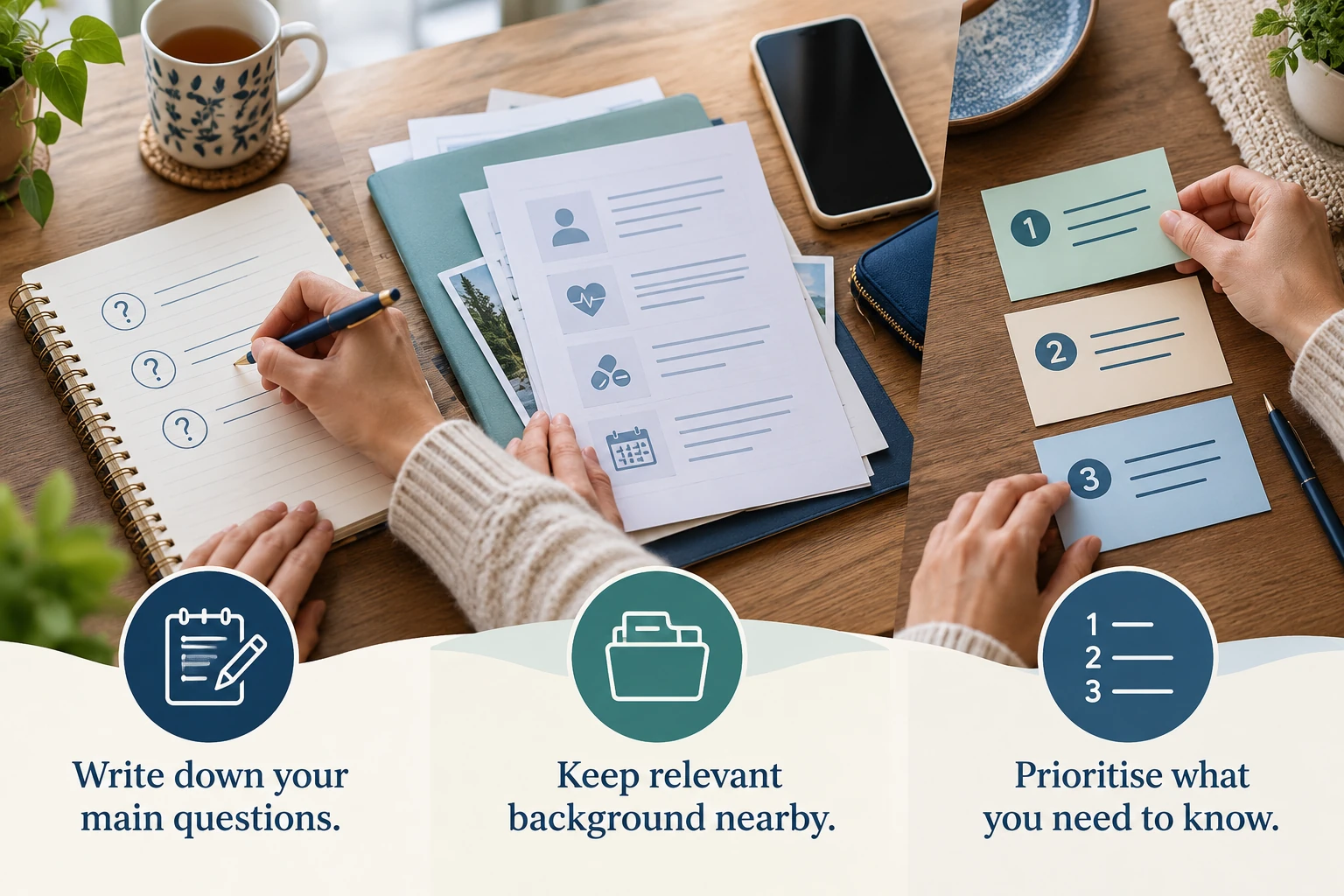
Prepare the questions that matter to you
You can use this checklist to organise your own questions before the conversation. It is a preparation aid, not a list of booking requirements.
What would you like to discuss, and which area concerns you?
What do you want to understand about the proposed treatment?
Which questions do you have about suitability, limitations, side effects or aftercare?
What needs clarifying about the total cost and appointment arrangements?
Would you like more time before deciding whether to proceed?
Write down any answer you want to revisit. If a term is unfamiliar, ask for an explanation in words that make sense to you.
Deciding after the call
The official page says you do not have to book treatment during the consultation. You can check your diary and discuss the next step later.
Before paying, review the current information on the official booking page and read the terms overview. Ask Lipo Sculpt to confirm the applicable cancellation and appointment-change conditions.
This page provides information and links. It does not collect payment, reserve a time or issue a booking confirmation.
A practical guide to preparing for the conversation
A consultation is easier to prepare for when you know what you want to leave understanding. You do not need a polished explanation or a decision about treatment. A small set of priorities can be enough: the concern you want to discuss, the questions you need answered and the practical details that affect your next step.
The sections below are an optional planning guide. They do not add medical requirements, a prescribed assessment or a promise about the contents of every call. Use the parts that fit your situation and leave out those that do not. Lipo Sculpt should confirm any instructions that actually apply to your consultation or appointment.
Keep your preparation proportionate. A few clear notes may be more useful than a long script. The aim is to make space for a discussion, not to anticipate every answer or arrive with a treatment plan already decided.
Separate your concern from your preferred solution
You may have found the website while searching for a particular treatment. If so, write down both the treatment name and the concern that brought you to it. Those two pieces of information are related, but they are not identical. The name identifies an option you have read about; your concern explains why you are considering it.
For example, someone researching the appearance of a particular skin concern may first review information about Lipo Sculpt skin imperfection treatment before arranging a consultation. Reviewing relevant treatment information can help you prepare more focused questions about what the service involves, its limitations and the costs that may apply.
Try describing the concern without using a treatment name first. Then add the option you have been researching. This leaves room to ask whether the connection you have made is the right one to discuss, rather than assuming that selecting a page has already established suitability.
If you are uncertain, say so. You can identify the question you want help understanding without choosing between several procedures yourself. Avoid presenting a conclusion as a fact simply because it appeared in a search result. The conversation is the place to clarify what the information means for the enquiry you are making.
Decide which questions are essential
Write your most important questions at the top of your notes. These are the points you would need to understand before making a decision, rather than every detail you might eventually want to know. A question about suitability or what the proposal involves may be more immediate than a question about a date several months away.
You can group the list into the treatment itself, the practical arrangements and the cost or conditions. Grouping helps you notice when an answer addresses one subject but leaves another open. For example, an available date does not answer a question about the treatment, and an explanation of the treatment does not establish the total cost.
Leave room to add a question during the call. Preparation is useful, but a conversation may introduce something you had not considered. If you need to pause and return to an earlier point, identify it clearly rather than trying to follow several unanswered subjects at once.
Explain the outcome you are hoping to understand
There is a difference between describing a hope and asking for a guarantee. You can explain what interests you about a treatment while still asking what its limitations are. Keeping both parts of the conversation visible can help you avoid treating an intended benefit as a personal prediction.
If a photograph, phrase or description has shaped your expectation, identify it. Ask what the information does and does not establish for someone considering the service. Do not assume that an example on a website represents the result you would experience or the arrangement that would apply to you.
You may also want to ask how the proposed approach relates to the concern you described at the start. This brings the discussion back to your reason for enquiring. The answer may give you more context, identify a point requiring further clarification or leave you with a question to consider before deciding what to do next.
Ask what suitability means for the option discussed
A general statement that an option exists does not answer whether it should be considered in your circumstances. During the conversation, ask what information is relevant to that question and how it will be addressed. Follow the specific instructions given by Lipo Sculpt rather than treating this guide as a medical checklist.
Where you are unsure whether a detail matters, raise that uncertainty with the consultant. You do not need to decide its significance on your own. Equally, avoid using an online description as a reason to omit a question you wanted to ask about your circumstances.
This page does not advise you to change medication, stop treatment or prepare your body in a particular way. If a proposed instruction is unclear, ask the appropriate professional to explain it before acting. The preparation discussed here concerns organising a conversation, not establishing that any procedure is suitable or providing instructions for receiving it.
Keep relevant background organised
You may find it useful to make brief notes about information you want to raise. Keep those notes factual and distinguish what you remember from anything you need to check. If the consultant asks for specific information, use the actual details available to you rather than guessing to fill a gap.
If you have previously discussed the concern elsewhere, consider which question remains unanswered now. You can explain that question without reproducing an entire history in your opening sentence. Let the conversation establish which additional detail is relevant and how it should be provided.
Do not send documents or photographs through an unrelated channel simply because you have them ready. Ask where any requested material should go and read the information at that destination before sharing it. There is no upload function on this page, and preparing a note here does not transmit information to Lipo Sculpt.
Understand the proposed treatment in ordinary language
If a treatment is discussed, ask for a description you can follow. Useful questions include what the service is intended to address, what the proposal involves and why that option is being considered in relation to your concern. The purpose is understanding, not learning specialist vocabulary for its own sake.
When a technical term appears, ask what it means in the explanation being given. A short clarification at that moment can be easier than trying to reconstruct the meaning after the call. If several methods are mentioned, keep their names separate in your notes so that information about one is not assigned to another.
You can also ask what remains to be established before any treatment decision. A preliminary discussion, a recommendation and a confirmed arrangement are different stages. Knowing which stage you are at helps you understand whether the next step is further information, a decision to consider or a practical booking action.
Make room for limitations and unanswered questions
A useful consultation is not only a list of intended benefits. You can ask what the option does not address, what uncertainties remain and which questions cannot be answered from general information alone. These points can affect your decision just as much as the description of the service.
If an answer is conditional, keep the condition with it. A statement that depends on suitability, availability or a later assessment should not be recorded as an unconditional arrangement. Writing down that distinction can prevent a misunderstanding when you return to your notes.
You do not need to force every question into a yes-or-no format. Sometimes the useful answer is an explanation of what must be clarified next. Ask how to follow up on an unresolved point, and avoid treating a missing answer as permission to assume the most favourable outcome. The aim is an informed decision, not a completed checklist at any cost.
Discuss the experience and aftercare questions
If you want to know what an appointment may involve, ask about the specific service under discussion. Keep questions about the experience, any instructions and the period afterwards connected to that service. An explanation for one treatment should not automatically be applied to another.
You might want to ask what information you would receive before attending, what you should understand before proceeding and how any aftercare instructions would be explained. These are suggested questions, not a claim that a particular instruction or support arrangement will apply.
If something in the answer would affect your plans, ask for clarification while the point is clear in your mind. Avoid planning around an assumption about how you will feel or what you will be able to do. This page does not supply recovery periods, restrictions or clinical instructions; obtain the advice relevant to the treatment and your circumstances from the appropriate professional.
Keep the consultation fee distinct from treatment costs
The published consultation information is shown near the top of this page. When you move from that information to a discussion of treatment, keep the two subjects separate. Knowing the consultation fee does not, by itself, tell you the price or payment conditions of a proposed treatment.
Before paying anything further, identify what the payment is for. Ask how the amount relates to the service being discussed and which conditions apply to it. If you have seen a different figure on another page or in earlier correspondence, refer to that information directly rather than trying to reconcile it by assumption.
Keep a record of the explanation you receive. Your notes should distinguish a published fee, an individual quote and an amount actually paid. This guide does not introduce discounts, payment plans or additional charges. It suggests questions to help you understand the real information before making a financial decision through the official route.
Ask about dates without assuming availability
If you have a preferred time for contact or treatment, make a note of it. You can explain your preferences while recognising that a suggested date is not the same as a confirmed appointment. Keep the practical discussion separate from the decision about whether you wish to proceed.
Where more than one date would work for you, identify the alternatives clearly. If your plans depend on a particular arrangement, say which point needs confirmation. Do not make travel or other commitments solely because a date was mentioned as a possibility.
After the conversation, check whether an arrangement has actually been agreed and what information confirms it. This page has no calendar, reservation function or availability feed. A button leading to the official booking page is a route to continue, not evidence that a time has been held. Rely on the specific arrangements communicated by Lipo Sculpt for your booking.
Clarify the setting for an appointment
Where an appointment would take place may be an essential practical question for you. Ask about the actual arrangement being considered rather than assuming that a general service description establishes a location. If a home visit is relevant to your enquiry, identify that preference and ask what needs to be confirmed.
Keep a note of the location or setting only once you have the applicable information. A region mentioned on a website is not necessarily the address for an appointment, and a general reference to a home-based option does not establish that it is available for every request.
If you are given practical instructions, read them in relation to the confirmed appointment and ask about anything unclear. This guide does not invent requirements for your home, a clinic visit or travel. The useful preparation is to identify the questions that matter to you and obtain the specific information before making arrangements around it.
Choose a comfortable way to take the call
Because the published consultation is described as a telephone conversation, consider when and where you would prefer to speak. Choose circumstances in which you can hear the discussion and refer to your own questions. This is a practical suggestion, not a condition of booking.
If a preferred time is important, explain it through the official contact or booking route. Check any response you receive rather than assuming that your request alone establishes the arrangement. If you need to change an agreed contact detail, ask the team how to update it.
You may want a pen and your questions nearby. Keep the notes short enough that you can listen instead of reading a script throughout. If an interruption means you miss part of an explanation, ask for the point to be repeated. A clear understanding of a few essential answers is more useful than a longer set of notes you are unsure how to interpret.
Use the call to check understanding
Near the end of the discussion, return to the questions you identified as essential. Look at whether each has been answered and whether any answer depends on a later step. This gives you a practical way to recognise what is settled and what is still open.
You can summarise your understanding in your own words and ask whether you have followed correctly. For example, distinguish the option being discussed from the action you have agreed to take next. If you are only reviewing information, keep that separate from any decision about a booking or payment.
Make a short note of unanswered questions while they are still fresh. Identify how you should raise them and whether you need to wait for further information. This is not a demand that every conversation must end with a treatment decision. It is a way to leave with a clearer account of the discussion than you had at the beginning.
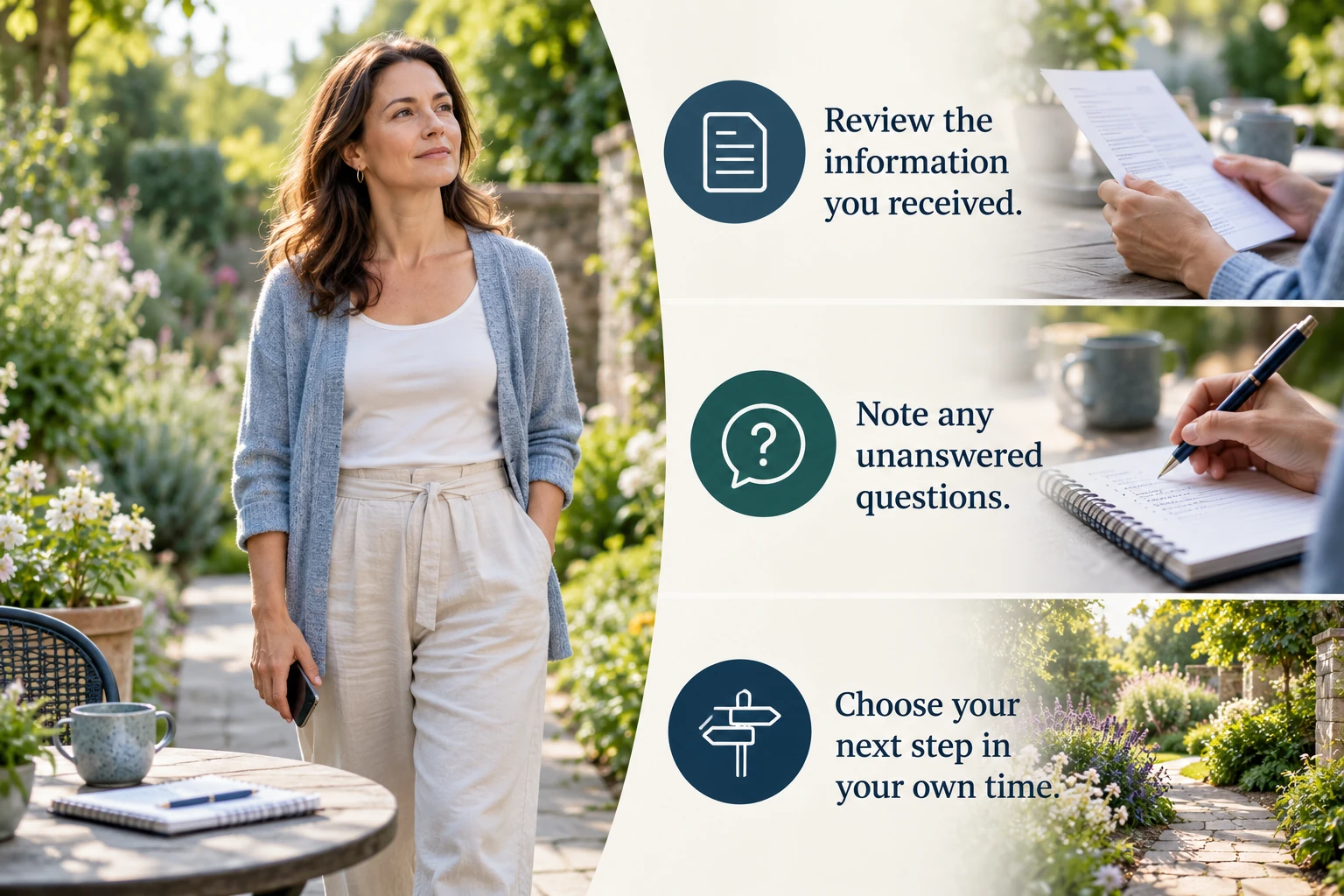
Taking time after the consultation
If you want to think about the information, use your notes to identify what you are considering. Separate a question that needs another answer from a preference you need time to weigh. The next step may be to clarify something rather than to repeat the entire consultation in your own mind.
Review the information relevant to the actual proposal. General descriptions elsewhere on the website should not replace the details discussed with you. If your notes and the written information appear to differ, identify the difference and ask for clarification before relying on either interpretation.
The published consultation page says you do not have to book treatment during the call. That gives you a clear distinction between having the discussion and choosing to proceed. This preparation guide does not add a cancellation right or change the terms of a payment already made; those are separate matters to check in the applicable published information.
Before following a payment link
Use the official booking destination linked on this page and read what it asks you to do. Identify the payment description and the information presented before deciding whether to continue. Do not infer the conditions of a payment from the appearance of a button on this informational page.
If the amount or purpose differs from what you expected, pause and ask Lipo Sculpt to explain the difference. Keep the actual details in your question so that the issue can be addressed specifically. Do not submit a payment merely to see whether it produces an appointment time.
This website does not process payment details or create a booking confirmation. It directs you to the official website, where you can review the current information. Keep any genuine confirmation or receipt you receive from the process you choose to complete, and ask the team about any practical booking detail that remains unresolved afterwards.
If your plans change later
A later question about an existing appointment is different from preparing for the consultation. Use the appointment details you actually received and explain the change you are requesting. Do not assume that the flexibility to suggest a date before booking establishes the conditions for changing a confirmed appointment afterwards.
The terms overview points out the different notice periods appearing in the official text. That ambiguity should be clarified with Lipo Sculpt for your booking. This page does not select one period, calculate a deadline or promise that a change will be accepted without a charge.
Keep the result of the conversation separate from your request. Until you have the applicable response, a proposed new date or cancellation remains something you have asked about. For the verified telephone number and enquiry route, return to Contact. Reading this guide or opening an external page does not itself notify anyone that your plans have changed.
A final check before deciding your next step
Look over the information you have gathered and identify the decision now in front of you. You may be deciding whether to arrange the consultation, whether to ask a follow-up question or whether to continue with a proposal discussed during the call. Those decisions do not require identical information.
For the next step you are considering, check that you understand its purpose, the practical arrangement and any payment or conditions attached to it. If one of those points is missing, turn it into a specific question. There is no need to fill the gap with an assumption taken from another treatment page or someone else’s experience.
The links on this page allow you to continue through the official route or contact the team first. Use the route that fits the question you are ready to address. The aim of this guide is a clearer conversation and a better organised decision, without suggesting that preparation itself establishes suitability, availability or a particular treatment result.
If you want to discuss more than one concern
You may have two or more subjects in mind when arranging the conversation. List them separately and identify which one you most want to address first. This can help you explain the purpose of the call without assuming that all concerns will lead to the same recommendation or arrangement.
Different concerns may also relate to entirely different services. For instance, someone researching pelvic floor support may have come across emsella treatment liverpool, while another concern may relate to an aesthetic treatment. Keeping the subjects separate makes it easier to ask relevant questions about suitability, expected limitations, appointment arrangements and costs for each service.
Ask how the discussion should be organised. If the subjects are connected, explain the connection in your own words; if they are unrelated, say so. Keep any answers attached to the relevant concern, particularly when a practical detail or limitation applies to only one of them.
Do not infer that mentioning several options establishes a combined treatment plan. A list of interests is information for the discussion, not an agreement to receive multiple services. Clarify what is actually being proposed and which decisions, if any, remain for a later stage.
Organising a focused follow-up question
After the call, you might identify one point you did not fully understand. Start a follow-up with that point and the context needed to recognise it. Refer to the actual conversation or information you received, rather than asking the recipient to reconstruct your concern from a general message.
If you have several follow-up questions, group them by subject. For example, keep a question about the proposed treatment separate from a question about a date or payment. This makes it easier for you to check whether the response has addressed each issue.
Retain the answer alongside the original notes and mark any change to your understanding. A follow-up should help resolve a specific uncertainty, not create a second set of assumptions. If the answer changes a practical arrangement, check what has actually been confirmed. The Contact page provides the verified route for continuing the discussion; this guide does not send a follow-up message on your behalf.